Is RPA a form of AI?
Not on its own. IBM draws the line plainly: RPA is “process-driven, whereas AI is data-driven”, and its bots “can follow only the processes defined by an end user” (IBM, read 5 November 2026). A classic RPA bot does not learn or decide; it repeats. The confusion comes from packaging. Vendors bundle bots with OCR, document AI and classifiers and sell the result as intelligent automation, where a model handles the reading and the bot handles the typing.
What business problem does RPA solve?
People acting as the glue between systems that were never connected. Someone copies order data from email into the ERP, rekeys bank lines into a reconciliation sheet, or creates the same new employee in five tools. Where those systems have no usable API, a bot can drive the screens instead, the same way a person would, and the record still lands in the right system of record. RPA pays off where the steps never vary and the volume is high: the bot is faster, never mistypes and works overnight.
RPA vs AI agents vs agentic process automation: what is the difference?
| RPA | AI agent | Agentic process automation | |
|---|---|---|---|
| How it decides | Fixed rules a person wrote | Reasons from the current state | Agents as the default way to automate processes |
| Handles variation | No, stops or fails | Yes, within its tools and limits | Yes, across a whole process portfolio |
| Breaks when | A screen, field or file layout changes | The goal or data is ambiguous | Governance and review are missing |
| Best for | Stable, high-volume steps | Reading, triage, exceptions | Replacing a brittle bot fleet over time |
An AI agent works through the same applications, sometimes by operating screens through computer use, but chooses its next step. Agentic process automation is the category shift: agents become the default way a company automates, instead of one more bot per case shape. The two now run side by side, not as rivals: even UiPath, a long-established RPA vendor, describes its platform as one “where AI agents reason, robots act, and people lead” (UiPath, read 5 November 2026).
When should a mid-sized company still use RPA?
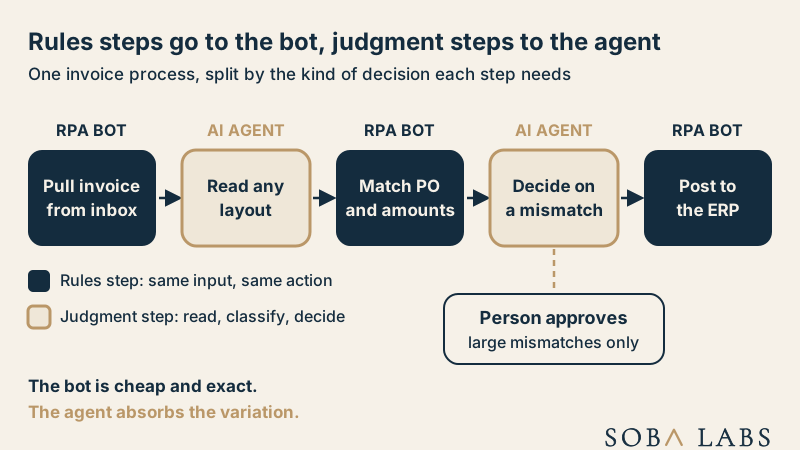
When the work is predictable and the cost of a wrong guess is higher than the cost of a stopped bot. Posting validated entries, moving files between fixed folders, filling the same form in a portal with no API: a deterministic bot is cheaper to run than a model call, gives the same result every time, and is simple to audit. Use agents for the judgment steps and bots for the rules steps, with a human in the loop on anything that moves money or reaches a customer. The expensive mistake is a fleet of bots patched weekly to cope with variation they were never built for; those are the first candidates to migrate. Plain workflow automation through APIs beats both wherever the systems allow it.