We design, build and harden agents on LangChain's open-source Deep Agents harness: planning, subagents, a virtual filesystem and durable runs on LangGraph, with LangSmith tracing and evaluations from the first week. Built by official LangChain Ambassadors and Experts, in your environment.
From a plain tool loop to a durable long-running agent.
Architecture
The right harness for the job
Deep Agents bundles a task list, subagents, a virtual filesystem and context compression on top of LangChain's agent loop. We start by checking whether the job needs that: many agents are better served by create_agent or a custom LangGraph graph, and we say so before anything is built.
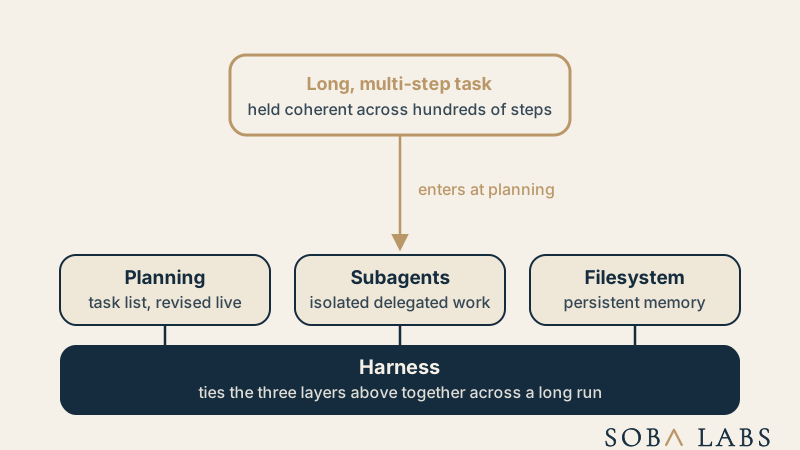
Research, coding and verification run as isolated subagents with their own context, and intermediate results live in the virtual filesystem instead of the conversation, so a run of hundreds of steps keeps its instructions in view.
Agent-written code runs in an isolated sandbox backend, never on the host, and sensitive tools pause for a person to approve, edit or reject through the harness's interrupt configuration, with the run resuming from its checkpoint afterwards.
Every subagent call, file write and tool call is traced in LangSmith, and a dataset of real tasks scores the whole trajectory, so a change to the instructions, skills or model ships only after it passes the same checks as the last one.
LangChain's hosted runtime, or your own infrastructure.
Managed Deep Agents
The hosted runtime, read honestly
Managed Deep Agents takes a code-first project (instructions, skills, tools, subagents) and runs it on LangSmith's Agent Server with durable threads, sandboxes, memory, approvals and automatic tracing, deployed from the mda CLI. As of October 2026 it is in public beta on LangSmith Cloud, in the US region only, and the docs offer no self-hosted or hybrid option for it. We can build on it when that fits, and we tell you when it does not.
The European path
The open-source harness in your EU environment
A team that has to keep data and compute in Europe today runs the same harness on its own infrastructure: the open-source deepagents package, a persistent LangGraph checkpointer and a sandbox provider you choose, with LangSmith tracing pointed at the EU region or a self-hosted instance. The agent definition carries over unchanged if you move to the managed runtime later.
Deep Agents is LangChain's open-source agent harness, the deepagents package, built on top of create_agent and the LangGraph runtime. It bundles a planning task list, subagents, a virtual filesystem, automatic context compression and skills, so an agent can carry a long, multi-step task such as research or coding without losing track of what it has done. The glossary entry explains the four layers.
When is Deep Agents the wrong choice?
When the task is short and well defined. A support reply, a classification step, a structured extraction or a fixed pipeline does not need a task list, subagents or a filesystem, and the extra prompt and tool surface costs tokens and adds failure modes. LangChain's own guidance is to use create_agent for a lighter harness and a custom LangGraph graph when the agent loop itself is the wrong shape. We recommend Deep Agents only when the work is long, varied and benefits from delegation.
How do you take a Deep Agent to production?
Durable execution first: a persistent LangGraph checkpointer so a failed or paused run resumes from its last step instead of starting over. Then a sandbox backend for any code the agent writes, interrupt configuration on every tool with a side effect so a person approves it, LangSmith tracing on every run, and an evaluation dataset of real tasks that gates each change to the instructions, skills or model. Memory and skills are reviewed as code, in your repository.
What is Managed Deep Agents and can we use it from Europe?
Managed Deep Agents is LangChain's hosted runtime for Deep Agents: you keep the agent definition in your repository and deploy it with the mda CLI, and LangSmith runs it on its Agent Server with durable threads, sandboxes, memory, human approvals and automatic tracing. As of October 2026 LangChain's docs state it is in public beta on LangSmith Cloud in the US region only, with no self-hosted or hybrid option. A European team that must keep data in the EU today runs the open-source harness on its own infrastructure and can move the same definition to the managed runtime later.
How is a Deep Agents engagement priced?
Like every Soba Labs engagement: a fixed price on a defined outcome, agreed before we start. You own the agent definition, the evals and the code.
We sell a fixed price on a defined outcome, delivered in days. Every system is custom to your process and your data, and you own it and its source. No product to license, no platform to rent, no lock-in.
No advertising or tracking cookies, and our visitor counts are anonymous. The Cal.com booking widget loads only if you allow it. Privacy Policy.
The page itself, anything our host sets to serve and secure it, and the anonymous visitor count. Always on, and none of it stores anything on your device.
The Cal.com booking widget. Left off, a booking link opens the booking page instead of a popup, so you can still book a call.
 LangChain experts