
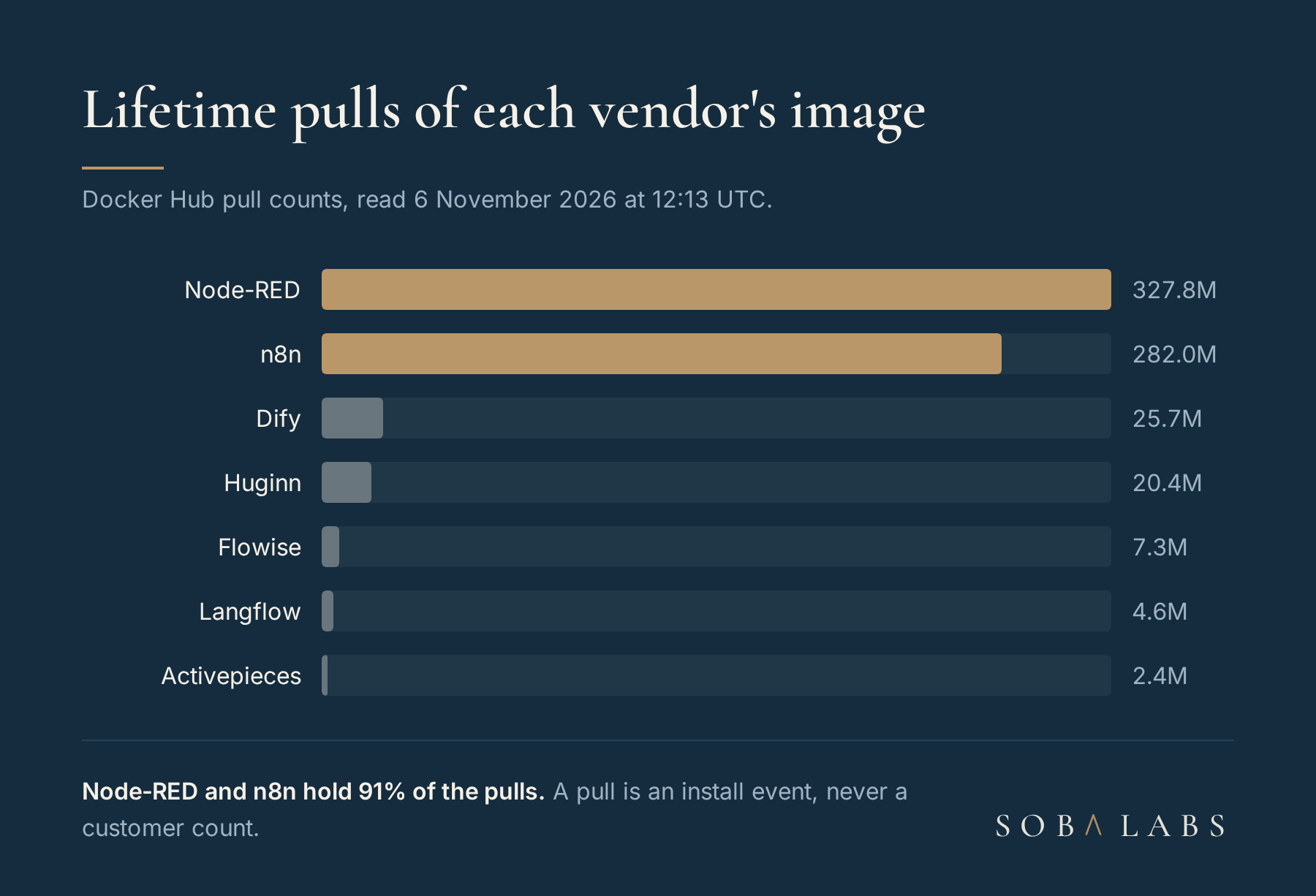
If you want to run workflow automation on your own servers, the public number that comes closest to showing what other companies run is how often each tool’s own container image is downloaded. On Docker Hub pull counts read on November 6, 2026, Node-RED and n8n hold 91% of the pulls across the seven self-hosted tools we ranked. Every other tool sits an order of magnitude below them, with Dify leading the AI app builders. Below is the ranking, what the count does and does not measure, what the n8n and Dify licenses allow, and where a flow canvas stops being the right tool.
Node-RED and n8n hold 91% of the pulls
The metric is one number per tool, the lifetime pull_count of the image the vendor itself publishes on Docker Hub, read at 12:13 UTC on November 6, 2026. A pull happens every time a server, a laptop or a CI job downloads the image, so it is the closest public proxy for how many places run a tool. We ranked tools a business team uses to wire systems together without writing an application, and that publish their own image on Docker Hub.
| Rank | Tool | Vendor image pulls | How the image describes it |
|---|---|---|---|
| 1 | Node-RED | 327,762,177 | Low-code programming for event-driven applications |
| 2 | n8n | 281,951,915 | Node-based workflow automation, fair-code licensed |
| 3 | Dify | 25,734,167 | Backend for the Dify AI application platform |
| 4 | Huginn | 20,442,796 | Agents that monitor and act on your behalf |
| 5 | Flowise | 7,274,640 | Low-code builder for LLM applications |
| 6 | Langflow | 4,588,526 | Low-code builder for RAG and multi-agent applications |
| 7 | Activepieces | 2,412,219 | Open-source business automation |
The seven add up to 670.2 million pulls. On our arithmetic, Node-RED leads n8n by 16%, and n8n has about 11 times the pulls of Dify, the next tool down. That gap is the finding. For workflow automation, a trigger firing a fixed sequence of steps, the self-hosted market has two incumbents and a long tail.
Node-RED leads the count, n8n leads the business case
Read the top two by what they are built for. Node-RED’s image calls it “Low-code programming for event-driven applications”, a general tool for wiring devices, data and services that reaches well beyond the back office. Its Docker Hub page shows 661,795 pulls last week alone, so the lifetime lead is still being added to.
n8n is the business automation tool of the pair, and its own Docker Hub page now leads with AI, promising to “Build AI agent workflows based on LangChain”. Its count is also likely an undercount. The run command on that page pulls from n8n’s own registry at docker.n8n.io, and on our reading those downloads would not reach Docker Hub’s counter. The commercial signal points the same way. In May 2026 n8n announced that an SAP strategic investment values it at $5.2bn, more than double the $2.5bn of its previous round, with a plan to embed n8n in SAP’s Joule Studio. If your system of record is SAP, that is worth knowing before you choose.
How we read it: Node-RED wins on raw installs across every kind of user, while n8n has the business automation focus and the investors. If you only automate office systems, n8n’s position is stronger than the 16% gap suggests.
The AI app builders sit an order of magnitude lower, and two have big buyers
Places three, five and six belong to a different kind of tool. Dify, Flowise and Langflow are visual builders for LLM applications: chat assistants, retrieval over company documents, and agentic workflows where a model chooses the next step. Together they have 37.6 million pulls, still smaller than n8n’s lead over Dify alone.
Read the ownership twice. On August 14, 2025 Workday announced it had acquired Flowise, describing it as “a low-code platform that makes it easy to build AI agents”. Langflow’s maker is in the same position. In February 2025 IBM announced its intent to acquire DataStax, the company behind Langflow, and said it would continue to support the open-source Langflow community. A new owner tends to steer the roadmap toward its own platform, and every flow you build inside one vendor’s canvas adds to the switching cost we call AI vendor lock-in.
Langflow’s count deserves a note of its own. It took 102,171 pulls last week on a lifetime base of 4.6 million, about 2.2% of its total in seven days, against about 0.2% for Node-RED, the only other tool whose page showed a weekly figure. Huginn, at fourth, is the odd one out. Its image promises agents that monitor and act on your behalf, which reads closer to scheduled watchers than to a business flow builder.
The license decides what you may build on it
Self-hosted does not mean you may do anything with it, and the two licenses worth reading closely are n8n’s and Dify’s. n8n ships under its own Sustainable Use License, which says “You may use or modify the software only for your own internal business purposes or for non-commercial or personal use.” Its enterprise files sit outside that license and need a valid n8n Enterprise License. That is fine for automating your own company. Building a product you sell to customers on top of it needs a commercial agreement.
Dify uses a modified Apache 2.0. Dify’s license file adds that “you may not use the Dify source code to operate a multi-tenant environment” without written permission, where one tenant is one workspace. For an internal tool that is rarely a problem; for a services firm hosting one instance for several clients it is the whole question.
So check the license against what you plan to do before the pilot starts. A tool you run internally, on your own servers, also settles most data sovereignty questions, because prompts and records stay in your own environment, which is often the reason a company self-hosts in the first place.
Is RPA a form of AI?
No. Robotic process automation copies a person’s clicks and keystrokes across application screens and follows fixed rules, so it is automation without judgment. None of the seven tools above is RPA either. They connect systems through their APIs, and a plain flow in Node-RED or n8n still does exactly what you drew, every time.
AI enters when a step has to read, classify or decide. We define that combination as intelligent automation in our glossary. It is the reason Dify, Flowise and Langflow exist, and the reason n8n now ships AI agent workflows beside its classic nodes. The newer label, agentic process automation, describes companies that make agents the default way to build process automation instead of adding one more scripted bot.
What Docker Hub pulls do not measure
A pull count is a usage proxy with known bends, and a ranking that hides them is not worth reading. Three bends matter here, plus one scoping choice of ours.
- Automation inflates it. A CI pipeline that rebuilds every hour pulls far more often than a company that installed once, so a pull never equals a customer.
- Other registries hide it. Pulls from n8n’s own registry, and from any tool that ships its images elsewhere, would not show in this counter. We left out tools without their own Docker Hub image for that reason alone.
- Cloud plans are invisible. A company on a vendor’s hosted plan never pulls an image.
- Our scope. We left out data pipeline and code orchestrators, which serve engineers moving data more than operations teams wiring business systems. That choice moves the tail of the list, where one orchestrator we excluded has more pulls than Activepieces.
Use the ranking to see who has the installed base, then judge the fit on your own process. The same caution applies to our ranking of Python AI agent frameworks, where downloads measure adoption and say nothing about quality.
Where a flow canvas stops and an agent graph starts
A flow tool is the right answer while the process is a fixed path. A form arrives, a record is created, a message goes out. The trouble starts when each step depends on a judgment the step before made. Our own localization pipeline work for Freedman International is that kind of process. It is a chain of decisions about a brief, a market and a brand’s rules, and we built it as a multi-agent reasoning service on LangChain and LangGraph with producers signing off. We build our LangChain work that way because a graph in code can be tested and versioned like any other software.
The same split runs through our own publishing. This blog is researched, drafted and illustrated by scheduled agent runs that end in a pull request, and nothing merges until automated checks pass. None of it lives on a flow canvas, because nearly every step has to reason about what came before.
For most mid-sized companies the practical answer is both. Let a citizen developer in operations own the fixed flows in n8n or Node-RED, and build the steps that need judgment as code with a human in the loop where a mistake is expensive. Our post on whether employees should build their own AI agents covers where that line usually falls, and the build vs buy decision decides who maintains each side.
The takeaway
On public install data, self-hosted workflow automation is a two-tool market. Node-RED and n8n hold 91% of the Docker Hub pulls across the seven tools we ranked, and n8n, likely undercounted, is the one built for business automation. The AI app builders Dify, Flowise and Langflow start from a much smaller base; Workday bought Flowise and IBM agreed to buy Langflow’s maker. Choose on the license and on how much of your process needs judgment, and use the count only to see who has the installed base.
Sources
- Node-RED official image on Docker Hub
- n8n official image on Docker Hub
- Dify API image on Docker Hub
- Huginn image on Docker Hub
- Flowise image on Docker Hub
- Langflow image on Docker Hub
- Activepieces image on Docker Hub
- n8n: valuation doubles to $5.2bn as SAP makes strategic investment (PR Newswire, May 12, 2026)
- Workday acquires Flowise (Workday newsroom, August 14, 2025)
- IBM to acquire DataStax (IBM newsroom, February 25, 2025)
- n8n Sustainable Use License
- Dify license