Why are AI data centers needed at all?
Because modern AI is one enormous, tightly coupled workload: thousands of chips acting as a single machine for weeks of training, then serving millions of users around the clock. Conventional data centers were built for many small, independent jobs; an AI data center is built for the giant one. For a buyer, the data center is the hidden line item in every AI price: the hyperscaler or neocloud behind your vendor passes its power, chip and construction costs through to the per-token price you pay.
What does an AI data center look like inside?
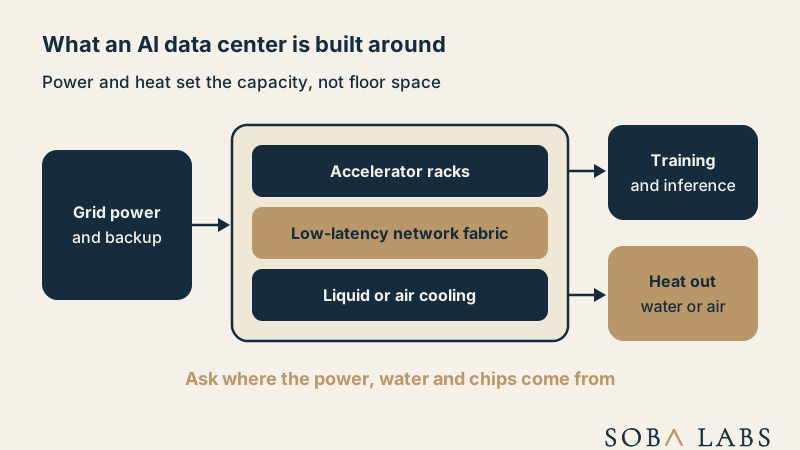
Inside, three systems matter more than floor area. Accelerator racks hold GPUs or custom chips packed far more densely than ordinary servers. A low-latency network fabric links them so a training run can treat thousands of chips as one computer. Cooling carries the heat away, increasingly as liquid piped to the chips, because air alone cannot keep up at those densities. Power, not square footage, is the unit these sites are measured in: Epoch AI’s tracker lists the largest known AI data center as Anthropic and Amazon’s New Carlisle site in Indiana, at 1,037 MW of IT power (Epoch AI, updated 1 November 2026).
Do AI data centers use too much power and water?
They are a real and growing load. The US Department of Energy reports that data centers used about 4.4 percent of total US electricity in 2023 and expects 6.7 to 12 percent by 2028, with consumption rising from 176 TWh to between 325 and 580 TWh (US Department of Energy, 20 December 2024, read 2 November 2026). Water depends on design: evaporative cooling consumes it on site, closed-loop liquid cooling uses much less, and the power plants feeding the site use water too. The footprint of your AI use is set by where and how it runs, which makes it a procurement question: ask which regions serve your workloads and what the provider reports on energy source and water.
Who builds and runs AI data centers?
Hyperscalers build the largest campuses for their own clouds and model partners; our rundown of the big five hyperscalers covers who they are. Neoclouds build GPU-only facilities and rent the capacity, compared in the top five neoclouds. Colocation operators build the shell, power and cooling that others fill with chips. Almost no mid-sized company should build one: renting through an API or a cloud is the normal path, and owning hardware pays only under steady heavy load or strict data constraints, the trade-off laid out under AI infrastructure.
What does the buildout mean for a company buying AI?
Three practical effects. Capacity sets price and availability: when new sites come online, prices for older models fall; when they lag, rate limits tighten and new models reach fewer regions first. Location sets compliance, since the region that runs inference decides data residency and any sovereign AI requirement. Concentration sets risk: your AI vendor is only as reliable as the data center underneath it, so ask which provider and region serve you and what happens when that region is full or down. Treat the data center as part of the vendor you are assessing, inside a normal vendor assessment.